What is punting in H2H categories fantasy basketball?
Updated
Punting means giving up one or two categories on purpose so the rest of your team is stronger. You stop paying for that stat, so the same picks and pickups buy more of the others. In head-to-head categories you only need to win most categories each week, so a team that gives up one and is strong in the other eight can beat a team that's average at all nine.
Why punting works
Every player costs you a draft pick, auction dollars or a roster spot. A player who's great at assists but bad at free throws takes up the same roster spot as one who's fine at both. If free throws don't matter to you, his weakness costs you nothing, and other teams will often pass on him.
In head-to-head categories you play a different team each week and win the matchup by taking more categories than they do: five of nine in a standard ESPN league. You don't have to be good at everything; you have to be better than this week's opponent at most things.
Punt categories that go together
Some stats come from the same kind of player, so giving up one makes the other easier to give up too. Measured over the last few ESPN seasons, these move together most:
- Rebounds and field goal percentage: big men get both.
- Threes and free throw percentage: shooters get both.
- Points and assists: guards who run the offense get both.
- Rebounds and blocks.
Two pairs that pull against each other
Don't punt both of these. Field goal and free throw percentage pull in opposite directions: big men who make shots near the basket often miss free throws. That's why punting free throws works so well. You can take those big men and win field goal percentage at the same time.
Assists and turnovers do too: players who pass a lot also turn it over, and in turnovers fewer is better. Giving up assists usually helps your turnovers, so the two make a good trade, not a pair to punt together.
Punt softly, and punt as little as you can
A punted category isn't worth zero. Your opponent may be weak in it too, and you'll still win it some weeks. Research on simulated head-to-head drafts found it works better, when ranking players, to still give a punted stat about three quarters of its normal weight than to ignore it completely.
Punting three or more categories rarely pays off in a nine-category league: you'd have to win five of the six left every week. One category, or two that go together, is the usual limit. And don't commit in the first round unless your first pick has one glaring weakness, like a star who turns the ball over a lot.
Each Category vs Most Categories
ESPN has two head-to-head categories formats, and they reward punting differently.
- Each Category: every category counts in your standings record. Win six of nine and you go 6-3 for the week. A category you punt all season costs you a loss in the standings every week, so punting is a smaller edge here.
- Most Categories: whoever wins more categories gets one win for the week. A 5-4 week and a 9-0 week count the same, so a category you'd lose anyway costs nothing. Punting is worth more in this format.
Punting for the season vs punting for the week
Season punting is a draft plan: you build the whole team to ignore one or two stats. Weekly punting is a matchup plan: you look at this week's opponent and give up the categories you can't win in this matchup, whatever your draft plan was. A weekly plan only aims at the five categories you need, so it can give up four for one week. That's fine for a single matchup; it isn't a season plan. They work well together. A team that punts free throws all season can still give up steals in a week its opponent is loaded with steals.
Fantasy IQ shows your weekly plans, punts included
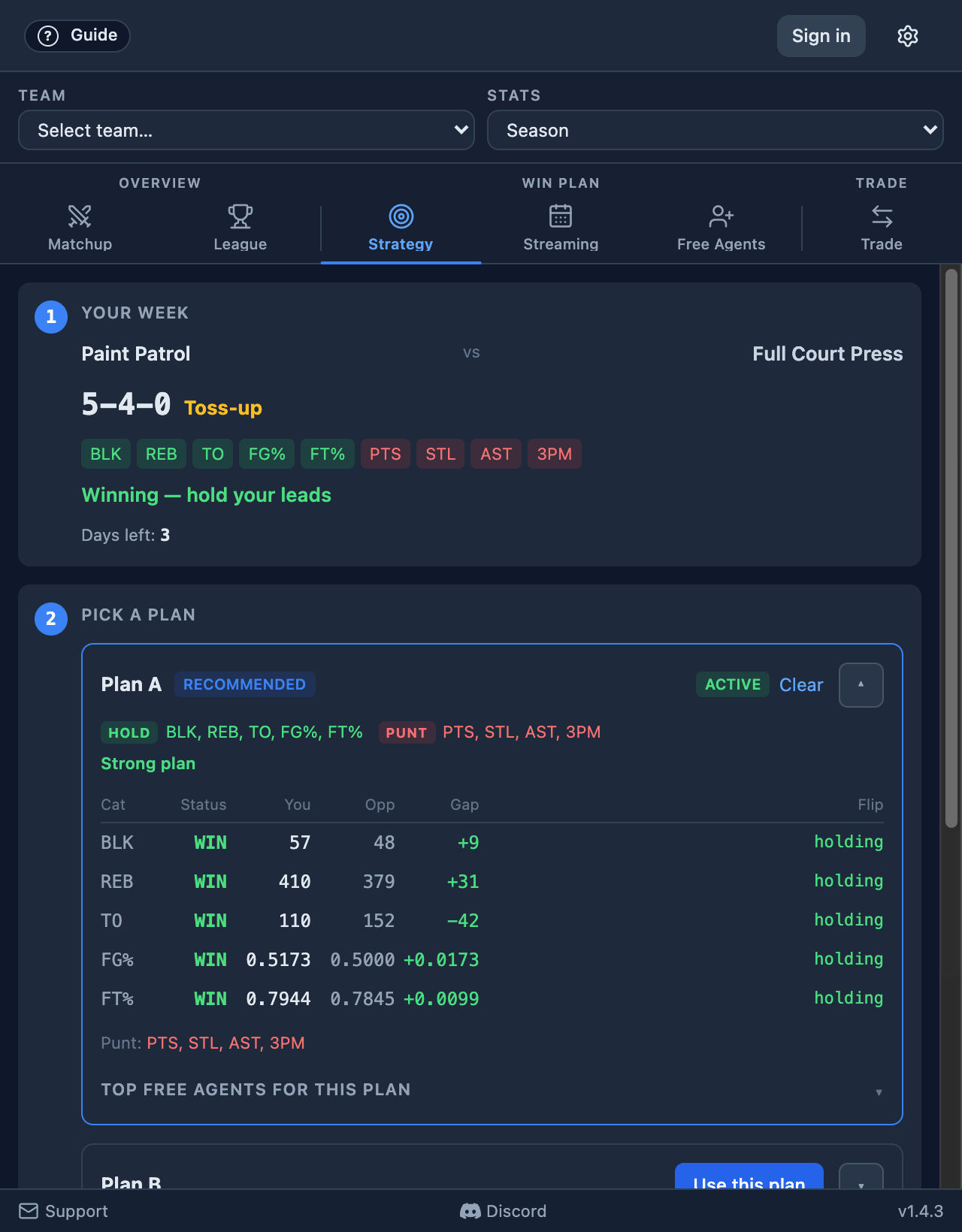
ChatGPT can't see your league, so it can't tell which categories are worth giving up against this week's opponent. Fantasy IQ is a Chrome extension that reads your ESPN league as you browse. Its win plan works out your chance in each category from the games left and lays out plans that hold, flip or punt, each with its chance of winning, and its free-agent scores change when you punt. In an ESPN auction draft room, its draft board suggests one punt, or two that go together, as your roster takes shape, and lets you choose your own. Works with ESPN head-to-head categories leagues.
Common questions
- What is the best category to punt in fantasy basketball?
- There isn't one best category. Free throw percentage and assists are the most common, because the players strong in the other categories are often weak there. Pick the one your first players are already weakest in, and pair it with a category that goes with it.
- How many categories should I punt?
- One, or two that go together, like threes and free throw percentage. In a nine-category league you need five to win the week, and every extra punt makes those five harder to get.
- Is punting worth it in ESPN Each Category leagues?
- It can be, but less than in Most Categories. In Each Category every category you lose counts as a loss in your standings record, so a category you give up all season costs you a loss most weeks.
- Can I punt a category for just one week?
- Yes. Look at this week's opponent and give up the categories you can't realistically win, then spend your pickups on the ones that are close. Next week, against someone else, the answer can change.